Group photo of Nikita Dragun, Laura Lee, Gabriel Zamora, and Manny MUA. Embedded Instagram post belonging and attributed to mannymua733. (2018, April 16).
The internet has seen many online thunderstorms, but non quite like the thunderstorm that hit the YouTube beauty community late last year. This time, it was all about beauty gurus and their old racist tweets.
Never before did people really begin to ask: what responsibility do popular online beauty gurus really hold, and should they be accountable for their past online remarks?
This recent discussion began with a feud between mega beauty-blogger stars – Laura Lee, Jeffrey Star, Manny MUA, Gabriel Zamora, and Nikita Dragun.
In true internet fashion, the feud involved YouTubers throwing around some shady comments at eachother, unfollowing eachother on social media platforms, and tweeting to their fans of the feud’s unfolding.
What followed was unexpected and almost career-ending for some of those involved.
Fans of Laura Lee’s now ex-friend Jeffree Star, dug up some of her extremely racist, fat-shaming, and unforgiveable tweets posted in 2012 and in 2013. For context, one tweet read:
“Tip for all black people if you pull ur pants up you can run from the police faster…#yourwelcome.”
Other than being grammatically incorrect, these remarks started a fire.
Following this revelation, fans began digging deeper, only to find racist things said by Jeffree Star himself. From there, Zamora and Dragun too, were exposed for inappropriate past tweets.
A true internet meltdown.
The discussion that followed asked a critical question: to what extent are popular and influential online figures responsible for the remarks they make online?
How does one forget to delete a blatantly racist and bigoted tweet in 2018?! I’ll wait… pic.twitter.com/IWvNVEKkYg
Tweet by remember me different @itsevab, replying to @Laura88Lee Embedded via Twitter link.
Today, more than ever before, regular kids, teens and adults are able to gain influence very quickly. With social media as their medium, they are able to draw in millions of viewers-turned-fans.
Many well-known beauty gurus have gained traction and eventually fame through social media platforms. Just Google how NikkieTutorials or James Charles acquired that social media celebrity status and you’ll understand what I mean.
The word fame is important here. When someone is famous or otherwise becomes publicly very known, a responsibility is presented. They have to not only consider the magnitude of their following, but also their reach to those who don’t directly follow them.
Laura Lee, Manny MUA, Nikita Dragun and Gabriel are all gettin what they deserve. Especially what they did to @JeffreeStar. It is 2018 and these top so called beauty gurus are a joke and bein racist! We are not here for racism sis! It should have never been said in the 1st place.
Tweet by Melissa @littledumpling6. Embedded using Twitter link.
Online creators such as Lee and Star are role models. They have a role to model and they are public figures. They may have started out as small-scale beauty bloggers, but as they turned into mega beauty ‘gurus’ they had to take a closer look at their online archives. They had to take responsibility.
Whether these tweets were from 2012 or not, Lee and Star were responsible for their past remarks. They held the responsibility of knowing their audience and shaping their online behaviour accordingly, both then and now.
They held and continue to hold a responsibility for their digital receipts because they are not just social media users, they are public figures who exert influence. People listen to them.
They also hold the responsibility of knowing that people are capable of digging into their digital archaeology and potentially using it as a weapon against them. Things they stand for define them, so they must define what they stand for.
But at the same time, people make mistakes and later change.
In this fast-paced world, we must have a little more forgiveness for one another online, considering the fact that someone’s intention 10 years ago is very likely to differ from their intention today.
Consider this NPR article on how much we change in 10 years:
We must also remember that the majority of online content creators are generally self-employed, or at least that is how they begin their career.
No employer or boss has conducted a background check on their past online actions. No one has ever interviewed them before they began blogging. No one has warned them about their online collections before they became famous and influential.
Do we cut them some slack? What if we said regrettable things online too? What if we don’t even remember?
With a generation that is growing up online, the expectation and pressure to self-govern is growing.
The expectation to upload only images that will profit our future employable selves; to write only things viewed as politically correct; to make jokes that could never possibly become outdated.
The expectation to continuously remember that we don’t own the internet, but that it owns us. The pressure to remember that the internet doesn’t forget and nothing is ever truly deleted.
No one wants to be in a video like this one day.
This YouTube video link is embedded and attributed to: PewDiePie (2018, October 6). Rating YouTuber Apology Videos.
So what can we do?
I wasn’t going to let you leave this article thinking: oh well, guess I’ll never post again.
Here are some steps you can take today to ensure your online tomorrow doesn’t suffer:
Conduct a social media archives cleanse.
GIF of a character from The Simpson’s TV show. Owned by and attributed to GIFHY. Embedded into this post: 2019, June 4.
Check your old posts: images, statuses, tweets, videos, to name a few. Know your history so that no one can surprise you later.
Think before you stink.
GIF of Winnie the Pooh ‘thinking.’ Owned by and attributed to GIFHY. Embedded into this post: 2019, June 4.
Memes and jokes are funny. Hilarious in fact. But before having to claim ‘it was just banter,’ think about what you are about to post, and probably forget about later.
Privatise your platforms.
GIF of a character from the South Park TV show. Owned by and attributed to GIFHY. Embedded into this post: 2019, June 4.
If you want to protect yourself and your privacy a little – start looking into your settings. Set things to private and consider: who are your Facebook ‘friends’ or Instagram ‘followers?’
Remember that you don’t have much control over how your past material is going to be treated. Lee and Star didn’t. Don’t put your temporary observations on the permanent and public internet.
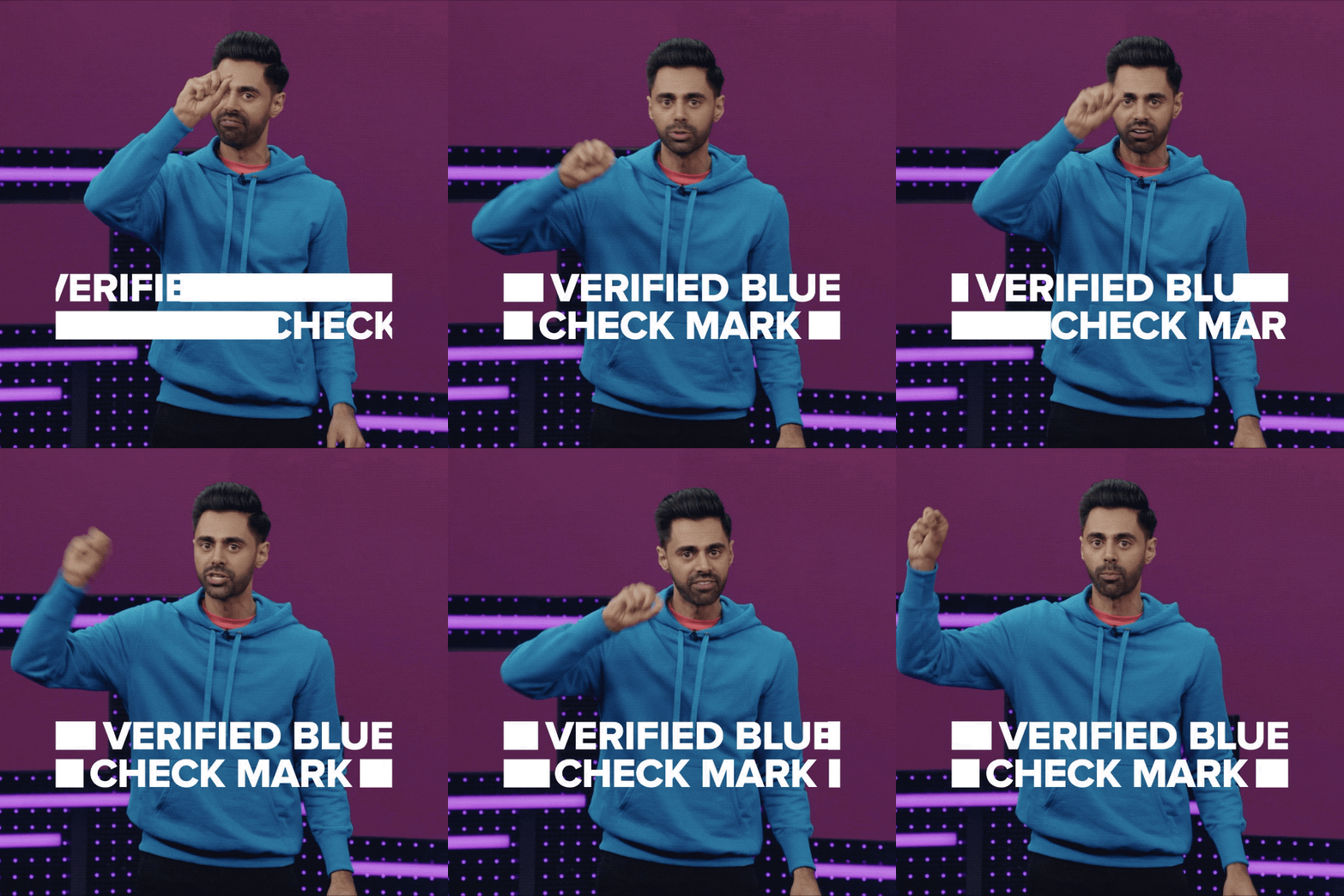
In a beauty-blogging world where it takes just a few minutes to become Instagram-verified, how do we begin to describe a truly influential, deserving public figure?
GIF of man ‘ticking’ in the air. Owned by and attributed to GIFHY. Embedded into this post: 2019, June 4
If you scroll down Kim Kardashian’s Instagram comment section, you will likely find someone selling ‘verification badges:’ aka the blue tick on an Instagram account.
I pretended to want one and found out that these sell for around $150-$2000, minimum.
The article below breaks down some pricing for you.
Widely perceived as the ‘tick of approval,’ an Instagram verification badge neatly sits next to your Instagram name, letting people know (or otherwise think) you are in some way, important.
Even worse – for free you can switch from a personal to a business profile on Instagram and plug in ‘Public Figure’ in your bio.
From the perspective of the beauty blogging world, and at a time where so many people wish to become ‘influencers,’ this poses a problem:
As followers and customers, how are we going to differentiate between those who worked hard to exert an influence and those who potentially bought their way into it?
And if we fail to carefully consider who truly deserves a ‘public figure’ or ‘influencer’ title, will its scope might just simply lose meaning?
It looks like it.
The question of who a public figure is or how the term is defined, hasn’t really been answered through a social media lens. It definitely hasn’t been widely debated when it comes to makeup and beauty bloggers.
Typically, a person who gains influence online does not gain it overnight. It takes hard work, passion, talent, inspiration, and a whole lot of good-quality content to step into the world of influence and to have an effect on a group of people.
Beauty bloggers who in my opinion fit the definition of an influential public figure are:
Kylie Jenner, Nikkie Tutorials, Jeffree Star, Anastasia Beverly Hills, Kat Von D, Huda Beauty, Zoe Foster Blake, and some others.
YouTube video of Nikkie Tutorials showing ‘The Power of Makeup.’ (2015, May 10). Video embedded from and attributed to NikkieTutorial’s YouTube Channel.
All of these people have worked extremely hard to combine their love for beauty with their interesting personality into an exciting, interesting, and follow-able empire.
To me, these are public figures.
But today, although cringe-worthy, in a few simple steps or a handful of cash, anyone and everyone with an Instagram handle can mask it with characteristics that scream ‘influence.’
Originally introduced by Instagram itself, the verification badge was used as an indicator for followers of celebrities and other A-lister accounts to differentiate between authentic and inauthentic profiles.
This is most certainly still true and celebrities can still be insta-verified with the blue tick, but so can a lot of other people.
GIF of ‘Like count.’ Owned by and attributed to GIFHY. Embedded into this post: 2019, June 4.
And if you don’t want to spend your dollars on that ‘tick?’ Don’t worry! Instagram has contributed to this culture of ‘wannabe influencers’ and made it extremely easy to acquire a ‘Public Figure’ label on your profile.
All this involves is switching from a personal to a business profile, linking the account to a Facebook Page (often made on the spot), selecting a category (People) and a subcategory (Public Figure) and behold: a social media influencer is born. (Sigh).
Never forget – anyone can mark themselves as a Public Figure on Instagram and even babies can talk.
For some perspective here, both your and Beyoncé’s Instagram profiles are able to hold identical verification badges…
GIF of Beyoncé being Beyoncé. Owned by and attributed to GIFHY. Embedded into this post: 2019, June 4.
Who would do this? Well, lots of people…maybe even a mill.
Google ‘how to get verified on Instagram’ and a plethora of results will flood your screen. For me, 1,000,000,000 results came up in 0.40 seconds. That craving for fame, influence and recognition has well and truly penetrated our generation.
Why does this matter?
Because not everyone on Instagram understands what the blue tick means, or how a ‘Public Figure’ status may have come to be.
Specifically, in a generation of (young) followers that thrive on following and interacting with someone that seems to be popular and with a legitimate-looking Instagram profile, being approved by the badge is misleading.
Beauty bloggers with big followings and verified accounts are essentially, a point of sale. They may be selling and/or promoting products, clothes, accessories, and more.
More importantly, though, they are selling a story.
That is, the story of the perfect life of an ‘influencer.’ A story that young people might try to imitate. A story that doesn’t always register with everyone’s digital consciousness.
Brand trips, wealth, social media popularity, edited pictures…it’s daunting to think that some of these beauty bloggers are shedding the popularity they gained through using unpopular methods, onto who they call their ‘fans.’
Design created by me using Canva. Link to article written by Megan Holstein regarding influencers selling a ‘perfect life’ story.
It’s daunting to think that more and more social media users are continuing to buy their way to influence rather than earning it.
It’s daunting to think that some of their followers will want to copy their actions.
It’s daunting to think that young people and especially kids, aren’t always fully equipped with the digital literacy of understanding who is a real public and influential figure and who is an imposer trying to sell them something, even if it’s just a story.
This has posed, and continues to pose, a very problematic problem. As for the ease of posing as socially important (or at least important on social media), the meaning of an influencer – and by extension, a public figure – is falling into an even greyer area than regular grey areas.
So I ask again: have we so widely disseminated the words ‘influencer’ and ‘public figure’ that they have now become meaningless?
GIF reading: ‘I am an Influencer and You are not. Owned by and attributed to GIFHY. Embedded into this post: 2019, June 4.
Sometimes, numbers lie.
Would you buy something recommended to you on Instagram by a ‘hip’ beauty blogger with 100,000 followers? There’s a chance.
What about a beauty blogger with 200 followers? Slimmer.
Now, what about if most of those 100,000 followers, were fake?
It’s 2019 and a time where some people’s job title can fully become ‘content creator.’ That’s fine. What is concerning, however, is that it seems some influencers are so about the numbers and titles that they forget to actually influence.
Is it time to start calling people out on inauthentic online behaviour and to stop supporting this ‘wannabe influencer’ culture we are living in? And why in the first place, are people buying followers?
GIF showing ‘live’ follower count. Owned by and attributed to GIFHY. Embedded into this post: 2019, June 4.
In November of 2017, one of my favourite makeup YouTubers, Chloe Morello, came out with a video explaining the concept of social media fraud.
She spoke about the fact that some beauty bloggers are simply buying their way to online popularity. Specifically, on Instagram and YouTube.
This is her video below.
YouTube video of Chloe Morello exposing instagram fraud issues. (2017, November 16). Video embedded from and attributed to Morello’s YouTube Channel.
In 17-ish minutes, she revealed to millions of loyal followers to beauty guru platforms that some of what they are seeing, might be fake.
She explained that some of her fellow peers in the beauty blogging industry (whom she did not name), are purchasing followers, likes, comments, views, and other forms of misleading engagement.
Essentially, she said that these bloggers are heavily relying on numbers to give them an attractive ‘influencer’ status.
Has buying followers to ignite popularity become part of their job, and why are people doing nothing about it?
As a technologically-savvy content creator this wasn’t new to me, but to many people this came as a big surprise. Suddenly a video wasn’t about ‘beauty secrets’ but rather ‘secrets about beauty (bloggers).’
A viewer of Morello’s video tweeted:
Chloe Morello has a YouTube video about some of these IG beauty pages that have mostly paid for likes, comments, followers. Basically all fake to entice brands.
Tweet by Tina Bina @CakemomD. Embedded via Twitter link.
Internet browsers were shocked to learn that the most work some beauty bloggers are putting into growing their platforms, is a click of a button.
GIF of YouTuber Joey Graceffa clicking ‘follow.’ Owned by and attributed to GIFHY. Embedded into this post: 2019, June 4.
All of a sudden, and after one post, their pages have 6,000 extra followers and 2,000 extra ‘likes.’
So let’s ask again: Has the internet become a place where bloggers are finding satisfaction in being a popular, selfie-posting ‘influencer’ rather than actually being influential?
But sometimes, numbers sell.
It was disappointing to find out that these bloggers are choosing to pay money in return for fake numbers.
This fake ‘influencer’ status may turn into brand deals, exotic overseas trips, invitations to cool events, and hundreds and thousands of free products and services.
On top of that, it includes brands pouring money into paying these bloggers for sponsored posts and expensive collaborations.
Even Forbes has raised the issue of inauthentic influencer marketing. Read their article below.
Suddenly, you might be seeing random beauty bloggers near you, promoting things like teeth whiteners and hair vitamins.
You then might purchase what they have suggested, using the influencer’s affiliate code, and this influencer goes home with money in his or her pocket.
And most of the time, we don’t even notice.
We’re in 2019. There are millions of us on social media. Some of us are real, some of us are generated robots (a.k.a. ‘bots’). Some of us see and scroll, and some of us scroll and troll.
Some of us have been on these social networking sites from the beginning, and for some of us, it’s just the beginning.
How often are we actually looking into the accounts we follow and questioning the legitimacy they hold? Probably not very often.
So how, among the social media cluster and noise, do we detect which of the accounts we follow, are genuine?
Easy.
Number 1: IG Audit
One very simple way to detect any unauthenticity on your feed is to simply plug Instagram usernames into the little search box using this link.
Assuming the profiles are set to ‘Public’ (anyone can see and engage with posts), results will show up within 15 seconds.
An example someone posted on their Instagram of their own IG Audit results. Embedded and used with permission. By: ityinkblots.
Results will show the user’s average vs. expected ‘likes’ and ‘comments,’ and provide a number titled ‘Estimated Real Followers.’
Real followers exclude bots and inactive or spam accounts.
If you are finding that someone’s Instagram account falls below the 60 or 50 percent mark, chances are him or her are either: buying followers, using bots, or happen to be followed by many inactive or spam accounts.
The last judgement, is up to you.
Number 2: Social Blade
The mother-ship of social media analytics and statistics, here you can track any social media user’s online growth. Searchable sites include YouTube, Twitter, Instagram, Facebook, and more.
Typically, a beauty blogger’s growth will fluctuate. Some posts will receive more likes & comments and attract more followers, while others will flop or won’t be seen by many.
This is normal and even expected.
Once on Social Blade however, if you see an influencer’s followers increase in ‘chunks’ (i.e. sudden boosts on the graph), rather than over time, chances are they are buying followers.
Responses to this issue continuously grows:
Trust me, it’s super obvious as well when you see someone’s follower count go up by 15k in a day 😂 website called social blade that tells you people’s stats. You can clearly see who’s buying fake followers 😬😬
Tweet by Its Palize @PalizeMusic. Embedded via Twitter link.
I wish Instagram would remove those who have bought fake followers and brands would stop working with them. It isn’t fair. Social Blade is a quick way to see these people jumping up 100k at a time. #BlogosphereChat
Tweet by Em Sheldon @emshelx. Embedded via Twitter link.
But luckily, over time, the truth comes out.
Numbers mean very little when the impact of the engagement is missing. Beauty bloggers growing their platforms using fake number will eventually be faded out.
This is because Instagram is always shutting down and suing companies selling fake engagement. They are also constantly filtering out unused, inactive, robotic, and spam accounts.
Additionally, marketers, small businesses, and big corporations will eventually pull out of deals with inauthentic beauty bloggers.
A great article to gain understanding of social media influencers’ marketing techniques as it relates to “buying followers”. It’s pretty incredible how much money is wasted each year by advertisers who are not in the know. #feetpeace#feetpeacefamhttps://t.co/TYm2EbGzBT
Tweet by Digital Hippie @dighip. Embedded via Twitter link.
If you are a marketer, you can find out more about fake influencers here.
And the same goes for us: the actual followers of these accounts; the fans; the potential consumers and clients.
As we come to learn how to detect these social media ‘fakers’ we will start clicking those ‘unfollow’ buttons and stop innocently and unknowingly supporting bloggers who have potentially bought their influence.
Because it may be easy for them to ‘fake it,’ but through shortcutting their way to online popularity, they will never actually ‘make it.’